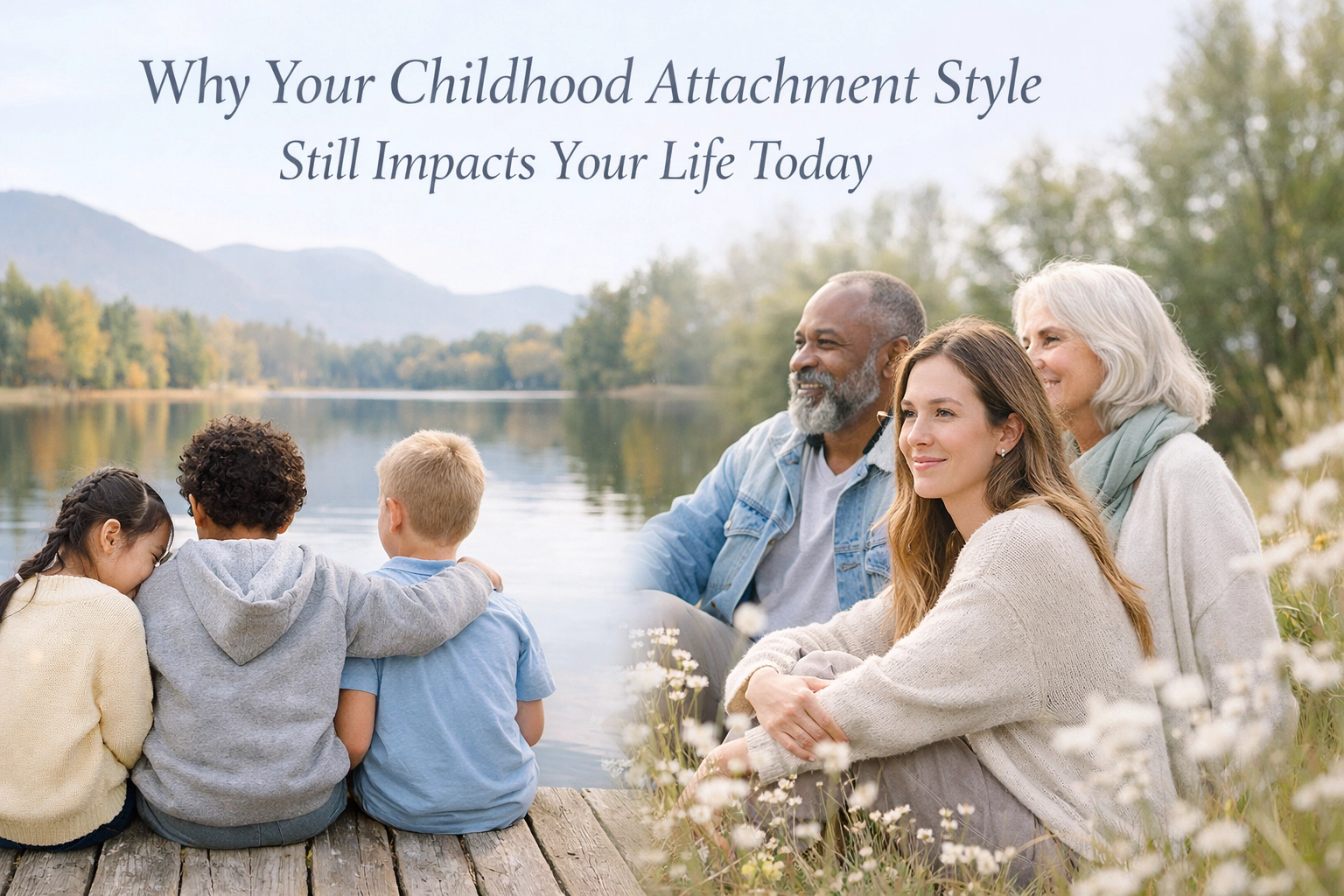
Have you ever found yourself reacting to a partner or a close friend in a way that felt almost automatic? Maybe you felt a sudden surge of panic when they didn’t text back right away. Or perhaps you felt an intense urge to pull away and hide when things started getting a little too “deep.” We often chalk these reactions up to personality quirks or just having a “bad day,” but the truth is usually a lot more profound. Your childhood attachment style is likely running the show behind the scenes.
At Thrive Wellness Clinic, we see so many wonderful people in the Maple Valley area who feel stuck in these repetitive emotional cycles. Whether you are navigating a new romance or trying to improve your relationship with yourself, understanding how your early years shaped your brain is the first step toward freedom. Here is the good news: while your past may have written the initial script, you have the power to edit the story.
What is a Childhood Attachment Style Exactly?
Attachment theory is not just a buzzword. It is a well researched psychological framework that explains how we relate to others. It started with the work of John Bowlby and Mary Ainsworth, who discovered that the way our primary caregivers responded to our needs as infants created a “blueprint” for all our future connections. By the time you were three years old, your brain had already developed a fairly stable pattern of how to seek safety and comfort.
If your needs were met consistently, you likely developed a secure attachment. If your environment was unpredictable, cold, or overly intrusive, your brain adapted to survive. These adaptations are what we call insecure attachment styles. Even though you are an adult now, your nervous system might still be using those same toddler-level survival strategies to navigate your grown up life.

The Secure Attachment Style: The Foundation of Trust
A secure childhood attachment style is the gold standard for emotional health. If you grew up with caregivers who were emotionally available and responsive, you learned that the world is a relatively safe place. You learned that if you have a problem, you can turn to others for help without losing your independence.
In adulthood, this looks like being able to trust others easily and communicating your needs clearly. You do not fear intimacy, but you also do not lose yourself in a relationship. You are comfortable with boundaries and can handle conflict without feeling like the world is ending. Even if you did not start with this foundation, we focus on helping you develop “earned security” through individual counseling and mindful practices.
Understanding Anxious Attachment in Adults
If your caregivers were inconsistent, sometimes warm and sometimes distant, you might have developed an anxious attachment style. As a child, you never knew which version of your parent you were going to get, so you became hyper-vigilant. You learned that you had to work hard to keep people close.
Today, this might manifest as a constant need for reassurance. You might worry that your partner is losing interest or feel a deep sense of unworthiness when you are alone. This childhood attachment style often leads to “people-pleasing” behaviors because your brain believes that being “perfect” is the only way to ensure you won’t be abandoned. It is an exhausting way to live, but with the right support, you can learn to soothe that inner child.
The Avoidant Attachment Style: The Wall of Self-Reliance
On the other end of the spectrum is the avoidant attachment style. This usually develops when caregivers are emotionally unavailable or dismissive of a child’s feelings. If you were told to “stop crying” or “be a big kid” whenever you were upset, you learned that showing vulnerability was a weakness. You learned that you could only count on yourself.
As an adult, you might pride yourself on being fiercely independent. However, when a relationship gets serious, you might feel suffocated or “crowded.” You might use work or hobbies to create distance. While it feels like you are just being “logical,” it is actually your childhood attachment style trying to protect you from the pain of rejection by keeping everyone at arm’s length.

Disorganized Attachment and Complex Trauma
Sometimes, a child’s source of fear is also their source of comfort. This happens in homes where there is abuse, neglect, or significant unresolved trauma in the parents. This leads to a disorganized attachment style. It is a state of “fright without solution.”
In your adult life, this can feel like an internal tug-of-war. You desperately want closeness, but you are also terrified of it. Your relationships might feel like a roller coaster of intense highs and devastating lows. If this resonates with you, please know that you are not broken. Your brain simply learned to survive in a very difficult environment. At Thrive Wellness Clinic, we specialize in what we treat, including this type of complex relational trauma.
How Your Attachment Style Impacts Your Daily Life
It is not just about your romantic partner. Your childhood attachment style influences almost every corner of your life. It affects how you handle feedback from your boss, how you interact with your children, and even how you treat yourself when you make a mistake.
For example, someone with an anxious style might overwork themselves to avoid any possible criticism. Someone with an avoidant style might struggle to form deep friendships because they stay on the surface level of conversation. By recognizing these patterns, you can start to pause before you react. You can begin to choose a response that aligns with the person you want to be today, rather than the child you had to be decades ago.

The Holistic Path to Healing at Thrive Wellness Clinic
At Thrive Wellness Clinic, we believe that healing is a whole person experience. You cannot just “think” your way out of an attachment wound because these patterns live in your nervous system. That is why our approach is holistic. We look at everything from your thought patterns to your physical lifestyle.
We might explore how mindfulness can help you stay grounded when your attachment system gets triggered. We look at how nutrition and sleep impact your emotional regulation. When your body feels safe, your mind is much more open to change. Our goal is to provide a compassionate space where you can explore your childhood attachment style without judgment. You can learn more about our philosophy on our blog or by checking out our reviews from other Maple Valley neighbors.
Moving Toward Secure Attachment
The most important thing to remember is that attachment styles are not life sentences. They are “plastic,” meaning they can change over time. This process is called moving toward earned secure attachment. It involves developing self-awareness, learning how to self-soothe, and eventually taking small risks in being vulnerable with safe people.
It takes practice to unlearn twenty or thirty years of survival strategies. It requires patience and a lot of self-compassion. You are essentially retraining your brain to believe that it is safe to connect. This is work that is best done with a guide who understands the nuances of human connection.

Matching You with the Right Therapist in Maple Valley
We know that walking through the door for the first time can be the hardest part. That is why we take the time to match you with a therapist who truly fits your needs and personality. Whether you are looking for someone like Janell Jordan who brings a deep understanding of relational dynamics, or Jai McCoy or Gina Davidson, we have a team of specialists ready to support you.
We offer therapy and counseling in Maple Valley, WA, because we believe our community deserves high quality, compassionate care right in their own backyard. You do not have to drive into the city to find expert help for your childhood attachment style. We are here to help you build the life and the relationships you have always wanted.
Your Next Steps Toward Healing
If you are tired of feeling like you are repeating the same relationship mistakes, it might be time to look a little deeper. Your childhood attachment style has a big impact, but it does not have to define your future. You deserve to feel secure, loved, and at peace.
Take a look at our patient resources or contact us today to schedule a consultation. Whether you are interested in individual work or perhaps group therapy, we are ready to walk this path with you. Let’s start the journey toward your most secure self today.